


MRT Rides in Temasektopia
I had a strange dream recently.
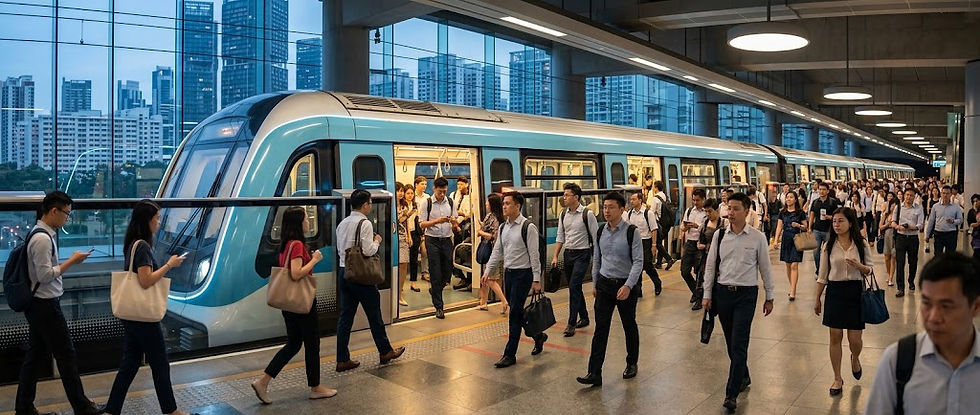
In it, I found myself visiting a futuristic city called Temasektopia. It was clean, efficient, technologically advanced—and, naturally, extremely proud of its public transport system.
The city’s pride and joy was its MRT, all using maglev trains, operated by an organization called the Levitating Trains Agency, or LTA.
What fascinated me was how people ride the trains. There are no fare cards, phones, QR codes or watches. Commuters simply walk through platform gates.
A camera looks at their faces.
Beep.
Gate opens.
As a researcher in biometrics, I could not resist finding out how this worked. Through the mysterious connections one acquires only in dreams, I soon found myself having coffee with the Chief Engineer of LTA.
The Chief
“So,” I began, “how do you manage the technology, economics, privacy and societal issues of using facial recognition for public transport?”
He smiled confidently.
“Very well indeed.”
That was reassuring.
“But facial recognition involves errors,” I said. “Broadly speaking, we worry about false positives, false negatives and misidentification.”
I explained that these errors involve trade-offs. A system can be tuned to make one type of error very small, but usually at the expense of the others. You cannot simply turn a knob labelled ACCURACY all the way to the right.
“Ah!” the Chief said. “But Temasektopia has unique characteristics.”
Apparently, every MRT commuter in the city was enrolled in the facial recognition database. Furthermore, only enrolled commuters could enter the station, because an entirely separate system checked them at the entrance. No outsiders allowed.
I paused.
“So everyone whom the facial recognition system sees is already enrolled, and tied to an eWallet?”
“Exactly.”
“Then you don’t really care about false positives involving unenrolled people?”
“Precisely!”
This allowed LTA to tune its system so that the false-negative rate—the probability that the system failed to recognize a legitimate commuter—was extraordinarily low.
“One in ten million!” the Chief declared proudly.
In other words, commuters were almost never rejected. No fumbling for cards. No dead phone batteries. No searching handbags while twenty people waited behind you.
Very impressive.
“But what about misidentification?” I asked.
Suppose Ah Beng walks through the gate, but the system decides he is Ah Seng. Ah Seng gets charged for Ah Beng’s train ride.
The Chief shrugged.
“That is determined by the facial recognition system.”
“Yes,” I said. “That’s why I’m asking.”
“We don’t solve it technologically. We solve it administratively.”
How?
Simple. If commuters find journeys on their bills that they did not make, they can dispute the charges and receive refunds.
“Easily?” I asked.
“Very easily.”
He paused.
“Within limits, of course.”
I decided not to ask what the limits were. Instead, I moved to privacy.
Privacy - not
“There is a principle in data protection called data minimisation,” I said. “You should collect only the data necessary for the purpose. To ride a train, the operator needs to know whether I have paid. It doesn’t need to know who I am. Why collect my biometric identity?”
The Chief looked puzzled.
“Our citizens don’t care about privacy.”
That struck me as unreal.
“Instead, they have chosen convenience,” he explained. “No cards. No devices. Their face is their ticket.”
“So nobody minds that the system could potentially record where they enter and leave the MRT every day?”
“No.”
“Where they travel?”
“No.”
“What time and with whom they travel?”
“No, and no.”
“And therefore, potentially, patterns about where they work, shop, visit, worship, or spend their evenings?”
He waved his hand.
“Everyone trusts the government.”
“What about hackers?”
“Our system is highly secure.”
“How secure?”
“Quite impossible to break into.”
I have heard variations of that sentence before, usually shortly before someone discovers a loophole.
“But suppose criminals somehow obtain the data?”
“We have very harsh penalties.”
I nodded. Apparently, cybersecurity in Temasektopia consisted partly of excellent encryption and partly of making hackers very scared of the consequences.
There was one last question.
“Who pays for all this?”
The Chief looked offended.
“What do you mean?”
“Thousands of cameras. Network infrastructure. Biometric software. Maintenance. Cybersecurity. Upgrades. Surely facial recognition costs considerably more than tapping a card? Surely some people have called this a vanity project?”
His expression became stern.
“This is not an expensive toy! We move millions of people every day! And we ignore the naysayers.”
“Of course,” I said. “So fares haven’t increased?”
“Well… they have doubled.”
“Doubled?”
“Only to finance the installation and maintenance of the system.”
I stared at him.
“But we cushion commuters from the impact,” he added quickly. “Every year, enrolled commuters receive Transport Vouchers.”
I tried to process this.
“So commuters pay higher fares to fund an expensive facial recognition system, and then the government gives some of the money back to help them afford the higher fares caused by the system?”
He smiled.
“Now you understand Temasektopia.”
At that moment, an alarm sounded.
The Chief jumped up.
“What happened?” I asked.
He looked at his phone.
“The facial recognition system has identified the Minister for Transport simultaneously at twelve different MRT stations.”
“And?”
“We’re not sure which one to charge.”
Then I woke up. Perhaps that is just as well.
Awakened
Facial recognition is an extraordinary technology, but technology does not abolish trade-offs. It merely moves them around—between errors and convenience, identity and anonymity, security and risk, cost and benefit.
Temasektopia solved those problems rather elegantly: citizens did not mind privacy loss, trusted the authorities completely, accepted occasional misidentification, tolerated hefty fare increases and were satisfied with refunds when things went wrong.
An ideal society. Alas, far removed from Singapore.

Comments